
Understand ABA therapy at home
When you bring ABA therapy into your child’s home, you’re weaving targeted learning moments seamlessly into daily life. This approach helps your child generalize new skills across environments, from the living room to the kitchen.
Instead of traveling to a clinic, your therapist observes your family’s routines and adapts interventions to real-world situations. You’ll see how daily activities—mealtime, playtime, even snack breaks—become opportunities to reinforce communication, social interaction, and self-help skills.
During each session, the therapist follows a behavior plan tailored to your child’s strengths and challenges. They collect data on progress, adjust strategies in real time, and coach you on prompting techniques. Having therapy at home reduces distractions and lets you participate directly in reinforcing positive behaviors. You’ll learn to carry the sessions forward between visits, which builds consistency and accelerates skill development.
Certification levels overview
When you start exploring in-home ABA services, you’ll encounter professionals with different certifications. Your child’s day-to-day work is often handled by a Registered Behavior Technician, or RBT. More advanced plans are designed and overseen by Board Certified Behavior Analysts at various levels. To see at a glance how each certification differs, review the table below.
| Certification | Education | Training hours and fieldwork | Exam format | Renewal requirements |
|---|---|---|---|---|
| Registered Behavior Technician (RBT) | High school diploma or equivalent | 40-hour training course | Task-based competency assessment | Annual renewal, ongoing supervision, ethics compliance [1] |
| Board Certified Assistant Behavior Analyst (BCaBA) | Bachelor’s degree | Verified Course Sequence, supervised practice | 140 multiple-choice, 4-hour exam | Biennial renewal, continuing education [2] |
| Board Certified Behavior Analyst (BCBA) | Master’s degree | Verified Course Sequence, 1,500–2,000 hours fieldwork | 160 multiple-choice, 4-hour exam | Biennial renewal, 32 CE units [1] |
| Board Certified Behavior Analyst-Doctoral (BCBA-D) | Doctoral degree | Same as BCBA requirements | 160 multiple-choice, 4-hour exam | Maintenance per BCBA rules [3] |
This overview clarifies who will handle your child’s goals, who designs those goals, and the level of expertise behind each plan. As you interview candidates, you can reference this table to confirm their credentials and understand the support structure around your family.
Training and education path
Each certification builds on the last, adding layers of education, supervised experience, and exam rigor. Understanding these requirements helps you set realistic expectations for your child’s therapist and the team providing care. Below, you’ll find a breakdown of what each role entails in terms of training and academic background.
Registered behavior technician
To become an RBT, the candidate must be at least 18 years old, hold a high school diploma or equivalent, complete a 40-hour training course, and pass a task-based competency assessment. A clear background check is also required before certification is granted [1]. Once certified, RBTs work under direct supervision to implement behavior plans crafted by a BCBA.
Board certified assistant behavior analyst
BCaBA candidates begin with a bachelor’s degree in psychology, education, or a related field. They complete a BACB-verified course sequence, undertake supervised fieldwork, and sit for a 140-question, four-hour exam. After passing, BCaBAs can design programs and provide limited supervision to RBTs, though a BCBA must still sign off on all treatment plans [2].
Board certified behavior analyst
To earn BCBA certification, you need a master’s degree in applied behavior analysis, education, or psychology along with BACB-approved coursework. Candidates log between 1,500 and 2,000 hours of supervised fieldwork before taking a 160-question, four-hour exam. Once certified, a BCBA designs individualized behavior plans, oversees data-driven adjustments, and supervises RBTs and BCaBAs [1].
Doctoral certification
BCBA-D credential holders have completed a doctoral or postdoctoral program in behavior analysis on top of BCBA requirements. Although the BCBA-D title does not confer expanded clinical privileges beyond the BCBA level, it signifies advanced research and leadership training. If your in-home therapist holds a BCBA-D, you can expect deep expertise in assessment methods and treatment innovations [3].
Essential therapist competencies
Credentials are the foundation, but you’ll want to work with someone who brings strong interpersonal skills and clinical judgment into your home. A great in-home ABA therapist listens carefully, tailors teaching moments to your child’s interests, and explains each step in plain language. Look for professionals who partner with you, treating you as a member of the team rather than an observer.
Data collection is at the core of ABA. Your therapist should record behaviors with precision, analyze patterns, and use that information to fine-tune strategies. Ask how they graph progress and how often they review data with you to ensure transparency and shared decision making.
Flexibility is another key attribute. Home environments can be unpredictable, so the therapist must adapt activities on the fly—whether a sibling walks into the room or the family dog gets excited. Creative problem solving ensures that every session stays focused on your child’s goals despite distractions.
Finally, compassion and calm demeanors help your child feel safe and supported. A therapist who remains patient in the face of challenging behaviors fosters trust and sets the stage for meaningful breakthroughs. You’ll notice the difference in how quickly new skills stick.
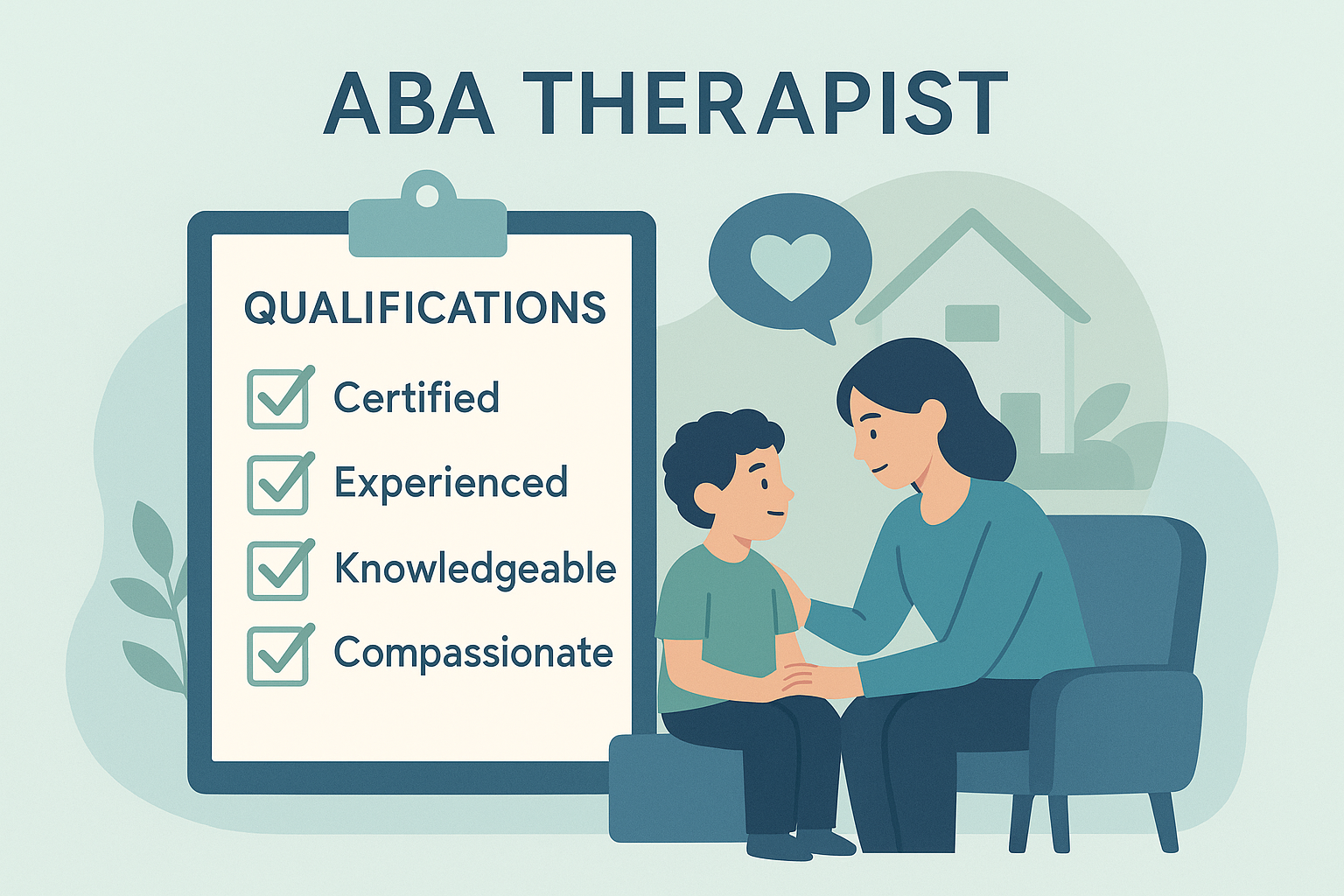
Build your qualifications checklist
To make sure you cover every detail, use this checklist as you interview and evaluate in-home ABA candidates. Work through each item, ticking off requirements before moving to the next step.
- Verify certification level (RBT, BCaBA, BCBA or BCBA-D) on the BACB registry or through training provider records.
- Confirm the therapist meets training and supervised experience guidelines for their credential.
- Request evidence of a clear background check and professional liability insurance.
- Ask about ongoing supervision arrangements and how feedback is communicated.
- Discuss experience with home-based programs and ask for references from local families.
- Check for specialized training in areas your child needs, such as communication delays or sensory integration.
- Ensure the therapist follows an ethical code and understands your family’s cultural values.
Running through these items gives you confidence that each professional you consider is qualified, vetted, and ready to partner with your family.
Finding a therapist near you
Now that you know what to look for, your next step is to connect with qualified providers in the Greater Asheville area. Start by asking your pediatrician for referrals and reaching out to local parent support groups or autism networks. Online directories like the Behavior Analyst Certification Board registry can help you confirm credentials before making contact [3].
When you schedule an initial consultation, prepare questions about the therapist’s experience, their approach to data sharing, and how they involve parents in session planning. A brief meet-and-greet can reveal not only professional skill but also how comfortable your child feels in that person’s presence. Trust your instincts, a good fit on paper won’t translate into progress if your child resists participation.
Finally, think long term. In-home ABA often spans months or years, and your therapist should be someone you can collaborate with over time. Discuss scheduling flexibility, cancellation policies, and how they adapt plans as your child grows. Establishing clear expectations upfront helps you focus on your child’s development, not logistics.
By following these steps, you’ll build a solid partnership with an ABA therapist who meets professional standards and fits into your family life. Ready to take the next step? Reach out today, and set up a time to talk through your child’s goals.