
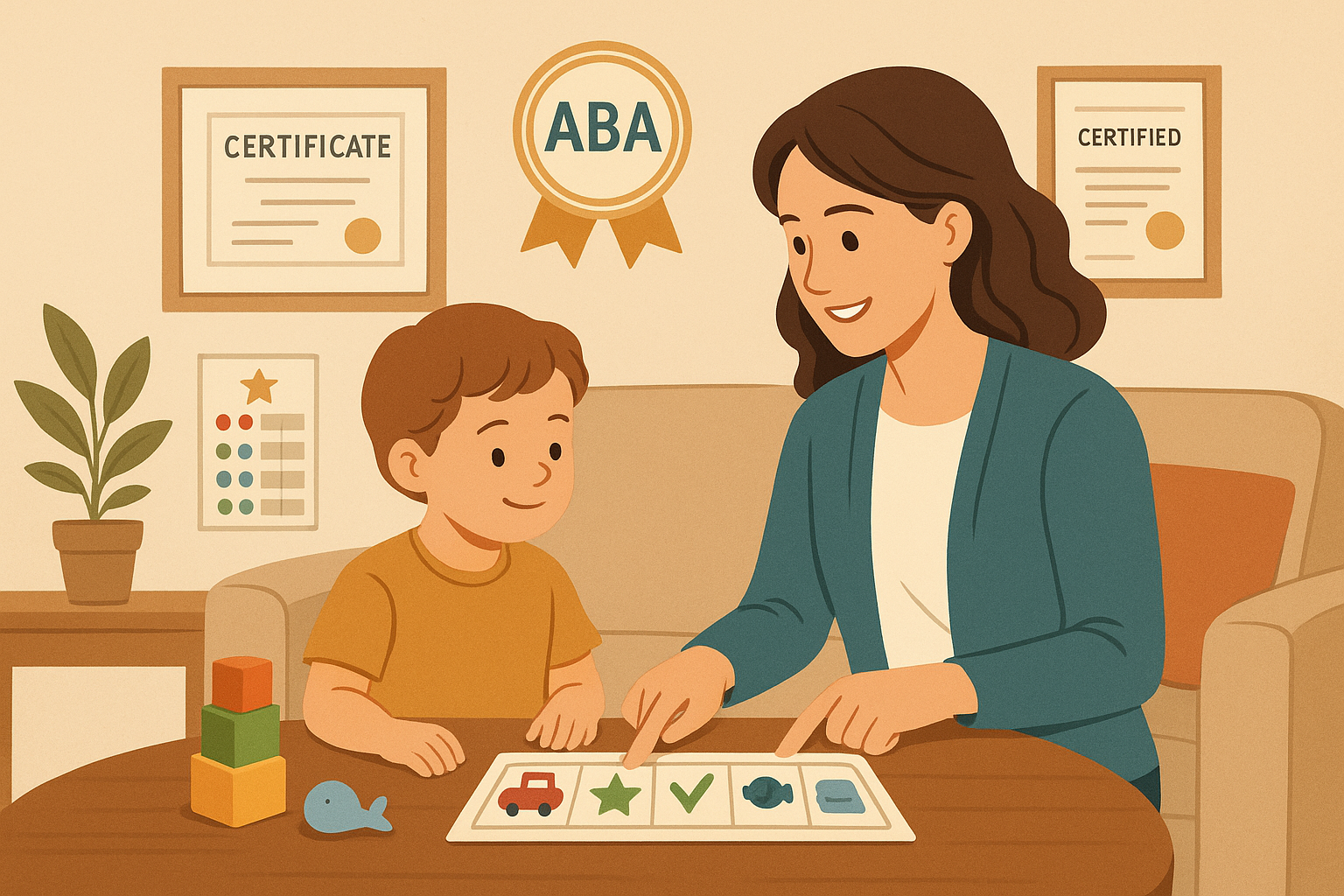
When you’re looking into aba therapy provider credentials for your child, you want clear information about who will be in your home, the training they’ve completed, and the standards they meet. Understanding the credentials behind an in-home ABA therapist helps you feel confident that your child is learning evidence based strategies, communicated clearly and compassionately. In Greater Asheville, NC, parents rely on therapists who not only know the science of Applied Behavior Analysis but also hold the right certifications and licenses.
This guide walks you through everything from entry-level paraprofessionals to doctoral-level specialists. You’ll learn what each credential means, the education and supervised experience behind it, how to verify licensure in North Carolina, and questions to ask as you choose the right provider. By the end, you’ll have a handy checklist of next steps to get the best possible support for your family.
Understand ABA credentials
ABA therapy provider credentials span multiple levels, each reflecting a deeper understanding of behavior analysis, ethical practice, and clinical skills. At the most basic level, a Registered Behavior Technician (RBT) implements plans under supervision. As you move up, Board Certified Assistant Behavior Analysts (BCaBAs) design simpler interventions while BCBAs and BCBA-Ds lead assessment, treatment, and training of staff. Here are the four main credential tiers you’ll encounter:
- Registered Behavior Technician (RBT)
- Board Certified Assistant Behavior Analyst (BCaBA)
- Board Certified Behavior Analyst (BCBA)
- Board Certified Behavior Analyst-Doctoral (BCBA-D)
Each title signifies a combination of coursework, fieldwork hours, and exam requirements—details you’ll explore in the next sections. Keeping these distinctions in mind helps you set realistic expectations for skill levels, specialization, and independence in therapy delivery.
Educational requirements for ABA
Different credentials require distinct educational backgrounds. Knowing what level of schooling corresponds to each credential helps you verify that your provider has the right knowledge foundation before they step into your home.
RBT training basics
To become an RBT, an applicant needs at least a high school diploma or equivalent. Then they complete a focused 40-hour training course covering behavior reduction techniques, data collection, and professional conduct. After training, candidates pass the RBT competency assessment and RBT exam. Once certified, RBTs work under the direct supervision of a BCBA or BCBA-D and must renew annually through a brief competency check.
BCaBA undergraduate path
If you encounter a BCaBA, you’re working with someone who has at least a bachelor’s degree plus approved coursework in behavior analysis. BCaBA candidates complete 5 to 12 university courses verified by the Behavior Analyst Certification Board (BACB), accumulate supervised fieldwork hours, and pass a 140-question exam. The BCaBA credential allows independent work only under BCBA supervision, but these providers often lead small teams of RBTs and assist with treatment planning.
BCBA graduate path
Most parents seek a BCBA to oversee their child’s program. Board Certified Behavior Analysts hold a master’s degree in Applied Behavior Analysis or a related field such as psychology or education. They must complete BACB-verified graduate coursework, accumulate 1,500 to 2,000 hours of supervised field experience, and pass a 160-question BCBA exam [1]. Once certified, BCBAs design behavior plans, train staff and family members, and make data-driven adjustments.
BCBA-D doctoral option
At the top tier, the BCBA-D is a BCBA who has also earned a doctoral degree. This isn’t a separate credential so much as a designation of advanced study. BCBA-Ds complete the same coursework and exam as BCBAs, plus additional doctoral requirements. They often lead research, supervise multiple BCBAs, and train at the university level. Maintaining BCBA-D status involves the same renewal process but with an extra designation fee [2].
Supervised experience demands
Formal education sets the stage, but supervised fieldwork builds practical skills. You’ll want to know how many hours your provider invested before they were cleared to work independently.
Fieldwork hours explained
To qualify for BCBA certification, candidates complete either 1,500 hours of concentrated experience or 2,000 hours of standard supervised fieldwork. This involves applying behavior-analytic principles in real-world settings such as clinics, schools, or in-home therapy. During these hours, trainees collect data, implement interventions, and receive regular feedback from a qualified supervisor.
State requirements overview
Licensing laws vary across the US, but North Carolina is among the 40 jurisdictions that require licensure and registration for behavior analysts [3]. Your BCBA must hold both national certification and a state license to practice independently. When you interview candidates, ask for proof of both BACB certification and North Carolina licensure.
Certification and licensure process
Certification through the BACB and licensure by your state board work in tandem. Understanding each step ensures you’re not handed a stale document or an expired credential.
BACB certification steps
First, candidates apply to the BACB, submit transcripts showing verified coursework, and document supervised hours. Once credentials are approved, they register for the standardized exam—160 questions covering ethics, assessment, intervention, and more. Passing rates can hover around 54 percent for first-time test takers, reflecting the exam’s rigor [4]. After you verify your provider’s BACB ID, you can confirm their status on the BACB’s website.
Renewal and ethics obligations
Both BCBAs and BCBA-Ds must renew every two years. Renewal requires 32 continuing education units (CEUs), including ethics training, plus documentation of professional activities. RBTs renew annually with a shorter competency assessment. Some states—though not North Carolina—have additional audit requirements, such as California’s Board of Behavioral Sciences continuing education standards [5]. Even if you live outside those states, look for therapists who proactively pursue CEUs beyond the minimum.
Choosing a qualified provider
Credentials are necessary but not sufficient. You also want someone who can connect with your child, respects your family’s values, and communicates clearly about progress.
Key questions to ask
When you meet a prospective therapist or agency, be prepared with these questions:
- Which credentials do you hold, and can I see proof of your BACB certification and North Carolina license
- How many years of supervised fieldwork have you completed in home settings
- What is your experience working with children similar to mine in age and skill level
- How often will we receive written progress reports and data summaries
Their answers tell you not just what credentials they have but how those credentials translate into real-world expertise.
Comparing provider credentials
When you compare candidates, a simple table can help you see differences at a glance. Below is a summary of each credential, typical requirements, and scope of practice.
| Credential | Education | Fieldwork hours | Exam | Practice scope |
|---|---|---|---|---|
| RBT | High school diploma + 40-hr training | N/A (supervised on the job) | RBT competency + exam | Implements plans under BCBA supervision |
| BCaBA | Bachelor’s + 5–12 behavior analysis courses | 1,000 supervised hours | 140-question exam | Designs simple interventions under BCBA supervision |
| BCBA | Master’s in ABA or related field | 1,500–2,000 supervised hours | 160-question exam | Independent assessment, treatment planning, staff training |
| BCBA-D | Doctoral degree + BCBA requirements | Same as BCBA | Same as BCBA | Research, advanced supervision, university teaching |
Use this chart to pinpoint which level aligns with your child’s needs and your expectations for autonomy, oversight, and expertise.
Supporting therapy at home
Your role as a parent shapes your child’s progress as much as the provider’s expertise. Building a partnership with your therapist ensures consistency and maximizes gains.
Partnering with your therapist
Start each engagement by sharing your family routines, communication style, and any concerns you have. A skilled BCBA will adapt interventions to your household’s pace, show you how to collect data during daily activities, and coach you on reinforcing positive behaviors. Consistent feedback loops—where you discuss what’s working and what feels overwhelming—create a collaborative environment.
Tracking progress and reports
ABA therapy is driven by data. You should receive regular graphs or charts showing progress toward goals like joint attention, communication milestones, and safe behavior reduction. Ask your provider to explain each data point in plain language. When you understand the numbers, you can reinforce strategies at home and celebrate milestones with your child.
Next steps for parents
Navigating aba therapy provider credentials may seem complex at first, but breaking it down into credentials, education, supervised hours, and licensure makes the process manageable. Start by listing the level of expertise your child needs, then confirm each candidate’s BACB certification and North Carolina license. Schedule conversations to discuss their experience, therapy approach, and communication style.
Once you find a provider whose credentials and personality fit your family, you’ll be on your way to a structured, data-driven plan tailored for your child’s growth. With clarity about credentials and a clear line of communication, you can feel confident that your child is receiving expert, compassionate support in the comfort of your own home.